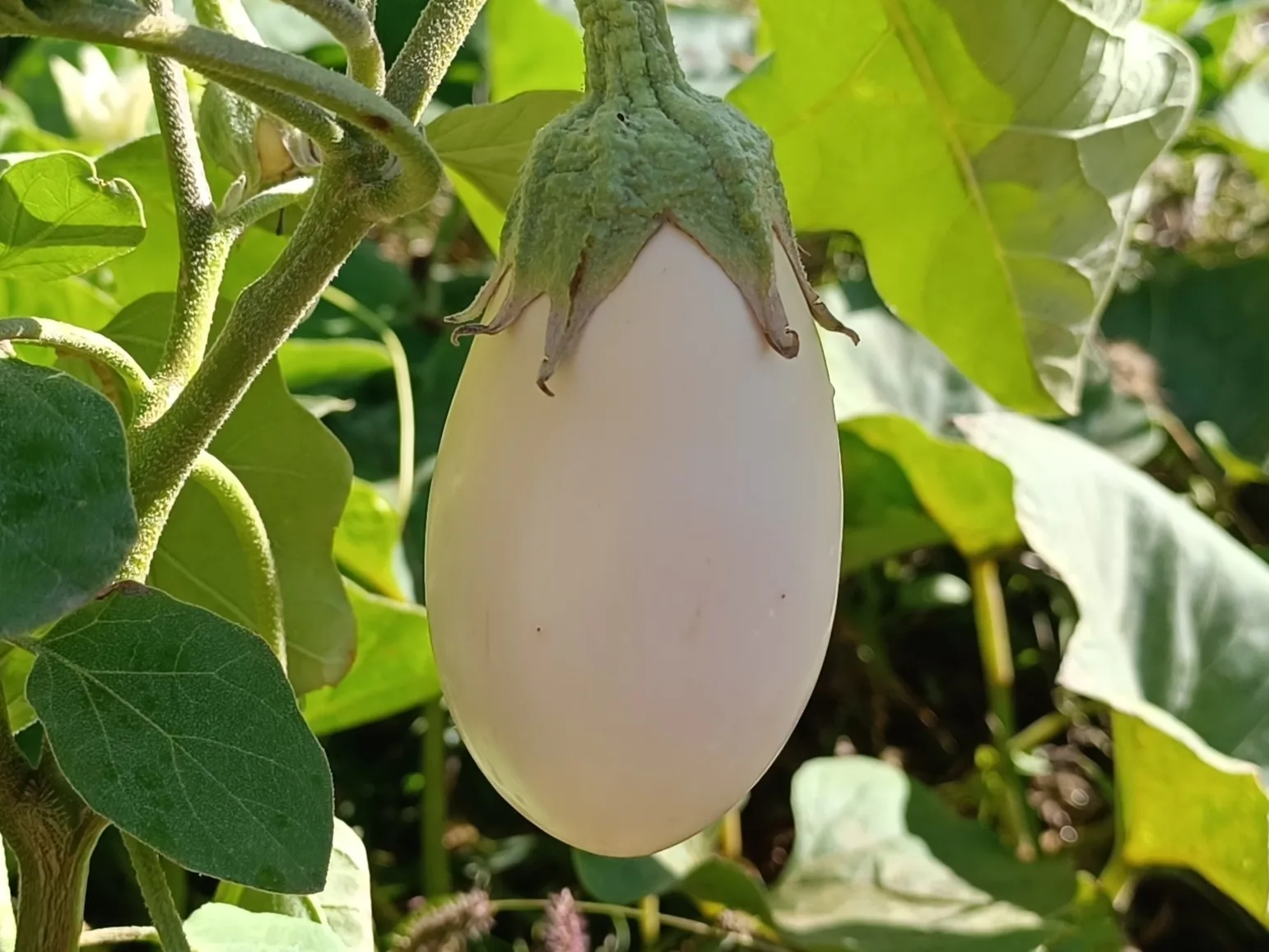
White Eggplant White

White Eggplant

Variety: White

Solanum melongena L.

About this Crop

White eggplant is a cultivated form of Solanum melongena in the nightshade family. The name describes the skin colour, not a separate botanical species or a single cultivar: varieties sold under this name may produce oval, elongated or small fruit. Seeds available in Spain include local selections, such as the one Cocopot lists as originating with Sadurní Playà in Manresa. Check the seed packet for the specific fruit shape and growing cycle of each lot.

The plant is upright and branching, with broad, slightly fuzzy leaves and usually violet, star-shaped flowers. Young fruit has white or ivory skin, pale flesh and small seeds. Harvest it while firm and glossy. If left on the plant too long, it loses its shine, develops tougher seeds, and its flesh may become spongy or bitter. Eggplant needs warmth and a frost-free growing season to crop well.

History & Origin

Eggplant (Solanum melongena) was domesticated in Asia and spread west along trade routes before becoming part of Middle Eastern and Mediterranean cuisines. Research on germplasm collections places the species’ diversity across several Asian regions and describes its domestication and relationship to wild relatives as complex. A single origin should therefore not be assigned to all white eggplants.

White forms have been documented in the United States since the early nineteenth century. Penn State Extension notes that Thomas Jefferson grew both a white and a purple eggplant at Monticello in 1812, and that garden catalogues began offering eggplant seed in 1825. Local seed selections are also maintained in Spain. A Cocopot product listing attributes its white eggplant to Sadurní Playà in Manresa, but that provenance applies to that seed lot, not to all white varieties.

Ideal Companions

BeanPeaLettuceOnionGarlicCalendula

Avoid

PotatoTomatoPepperOther eggplants

Superfood

White skin does not establish a distinct nutritional profile for this selection: the available figures are for raw eggplant in general. Per 100 g, it provides about 25 kcal, plenty of water and fibre, and small amounts of potassium, folate and vitamin C. The flesh contains phenolic acids, including chlorogenic acid. Anthocyanins are concentrated mainly in purple skin, so white eggplant should not be assumed to provide the same amounts of these pigments.

Preservation

Eggplant spoils soon after harvest. Unwashed fruit can be kept for a day or two in a paper bag in a cool place. It will keep for about four or five days in the warmest part of the refrigerator, although prolonged chilling may mark the skin. To freeze it, slice and blanch for about four minutes in water with lemon juice, then cool, drain and pack. Do not preserve eggplant in jars using a boiling-water bath unless following a tested recipe for low-acid foods.

Pest Monitoring

Pay special attention to: flea beetle, aphid, whitefly, spider mite, downy mildew, verticillium wilt.

FAQ

Is white eggplant a different species from purple eggplant?

No. White and purple garden eggplants usually belong to Solanum melongena. Colour and shape depend on the variety or line being grown.

When can it be harvested?

When the fruit has reached the variety’s typical size, is firm and still has glossy skin. The exact timing varies with the selection and growing conditions.

Is white eggplant less bitter?

Some white varieties are described as mild, but flavour depends on the cultivar and ripeness. Harvesting before fruit is over-mature helps prevent spongy flesh and hard seeds.

Can it be preserved in a boiling-water bath?

Canning eggplant on its own using this method is not recommended. It is a low-acid vegetable and requires a tested preservation recipe; blanching and freezing is a safer home option.

Why do the flowers drop without setting fruit?

Cold, overly warm nights, intense heat or irregular watering can reduce flowering and fruit set. Keeping the plant warm and moisture levels steady usually improves production.

Notas

“White eggplant” is a type name, not a complete cultivar identification. Shape, size, earliness and whether the seed is open-pollinated or hybrid depend on the lot. Cocopot’s product listing links one specific selection to Sadurní Playà in Manresa; retain that provenance when saving or exchanging its seed. The nutritional figures and general growing advice here are not analyses specific to that selection.