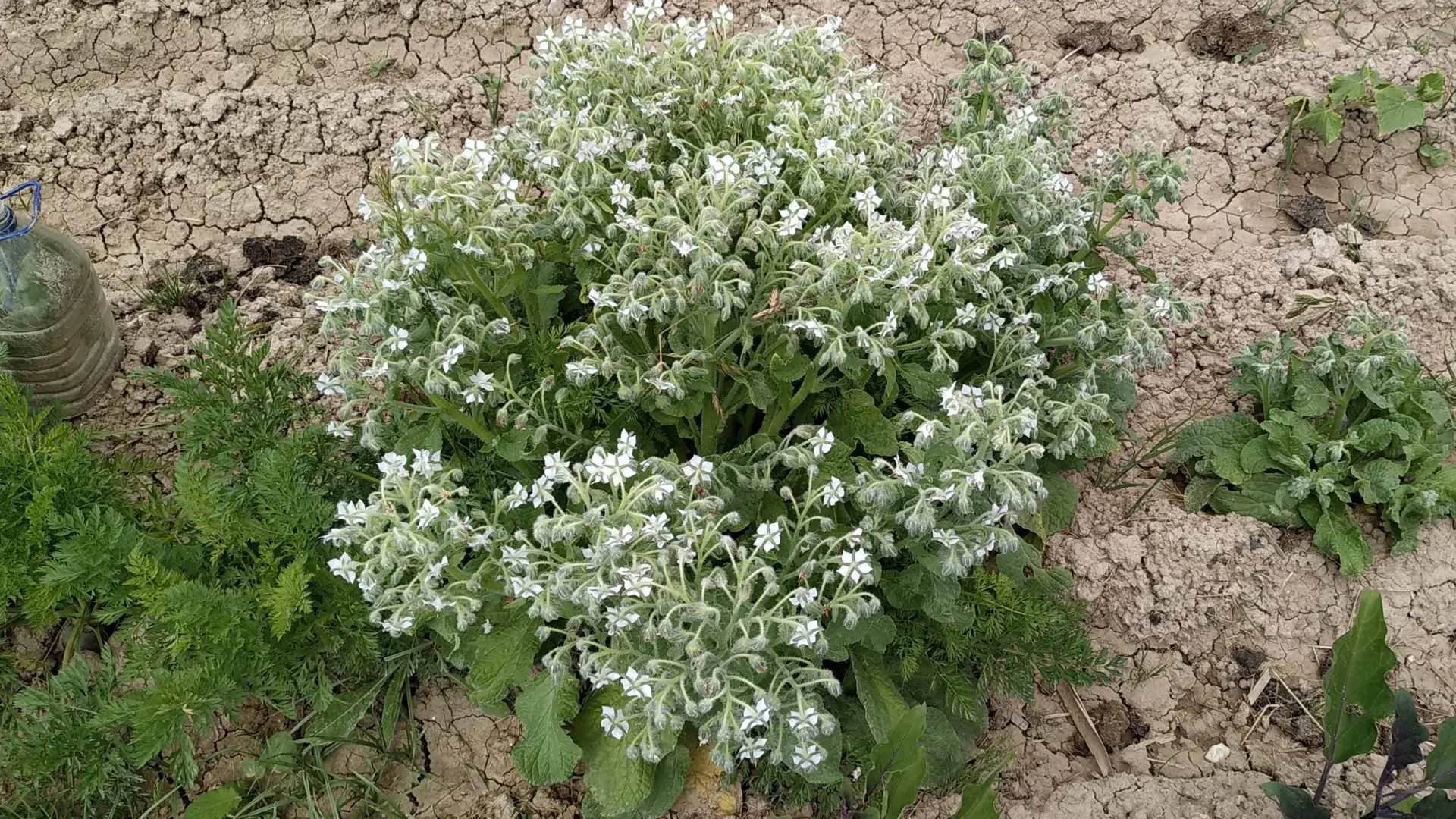
White-Flowered Borage Flor Blanca

White-Flowered Borage

Variety: Flor Blanca

Borago officinalis 'Alba'

About this Crop

White-Flowered Borage (Borago officinalis 'Alba') is a variety of borage with white flowers —unlike common blue-flowered borage—, equally prized for its culinary and medicinal properties and as a bee plant. It is a less common variety but highly valued for the aesthetic purity of its white star-shaped flowers.

It belongs to the Boraginaceae family, a botanical family different from all previous entries. It is an annual herbaceous plant with an upright, branched habit, reaching 40-90 cm in height. The entire plant is covered with stiff, rough hairs that give it a characteristic texture. The leaves are large, oval, and alternate, of a greyish-green color, with a flavor and aroma reminiscent of cucumber.

Its flowers are white, star-shaped, and nodding, with five pointed petals, grouped in clusters. They are heavily visited by bees and bumblebees, making it an excellent plant for attracting pollinators to the garden. It is a fast-growing plant and a prolific self-seeder: once established, it usually reappears year after year without needing to be replanted.

History & Origin

Borage is native to the eastern Mediterranean region (Syria and Egypt) and has been used by humans since classical antiquity. The Romans spread it throughout the Empire, and Pliny the Elder already mentioned it in his Natural History for its mood-lifting properties.

During the Middle Ages, borage was cultivated in monasteries throughout Europe and was known as euphrosinum (that which gladdens the heart). The famous English herbalist John Gerard wrote in 1597 that borage leaves in salad "reanimate and gladden the melancholic man." Crusader knights drank wine with borage flowers before battle to imbue themselves with courage.

In traditional Spanish cuisine, borage is an emblematic ingredient of the Aragonese garden, especially in Zaragoza and its surroundings, where it is consumed sautéed with garlic and olive oil. The White-Flowered variety ('Alba') is a less common mutation than the blue-flowered one, selected for its ornamental value and the purity of its white flowers. The name Borago may derive from the Arabic abu rach, meaning "father of sweat," in reference to its diaphoretic (sweat-inducing) properties.

Ideal Companions

TomatoStrawberryZucchiniCucumberCabbagePeaLettuce

Avoid

PotatoFennel

Superfood

Borage is rich in mucilage, tannins, potassium, and calcium. It is especially valued for its content in gamma-linolenic acid (GLA), an omega-6 essential fatty acid present in its seeds and leaves, beneficial for skin health and hormonal regulation. It also provides vitamin C, vitamin A, and fiber. It is a diuretic and depurative plant, traditionally used for kidney and respiratory health. It contains pyrrolizidine alkaloids in small amounts, so moderate consumption is recommended.

Preservation

Tender leaves keep in the refrigerator for 2 to 3 days wrapped in a damp cloth, although they are very perishable and oxidize quickly. It is best to consume them on the same day of harvest. The flowers last only a few hours at room temperature; to extend their life, they can be frozen in ice cubes to decorate drinks, or crystallized with sugar for pastry. The leaves can also be blanched and frozen, although they lose texture.

Pest Monitoring

Pay special attention to: Aphid, downy mildew, slug.

FAQ

Is borage invasive

It is not invasive in the strict sense, but it self-seeds very easily. If faded flowers are not controlled, it can appear throughout the garden. It is easy to pull out if it grows where it is not wanted.

The leaves are prickly to the touch

Borage is covered with stiff hairs that can irritate sensitive skin. It is recommended to wear gloves when harvesting. When cooked, the hairs soften and any discomfort disappears.

Can it be eaten raw

The youngest, most tender leaves can be eaten raw in salads, finely chopped, and have a refreshing cucumber flavor. Older leaves are too rough and are recommended to be cooked.

What are borage flowers used for

The flowers are edible and are mainly used as decoration in salads, desserts, and drinks. They can also be crystallized with sugar or frozen in ice cubes for cocktails. They also attract bees and bumblebees to the garden.

Notas

White-Flowered Borage is one of the best companion plants for the garden, as it attracts pollinators and improves the production of tomatoes, strawberries, and zucchinis. Its white flower makes it especially attractive in night gardens or white gardens. It is important to consume borage in moderation due to its pyrrolizidine alkaloid content; daily consumption or large quantities are not recommended. People with liver problems or pregnant women should consult a professional before consumption.