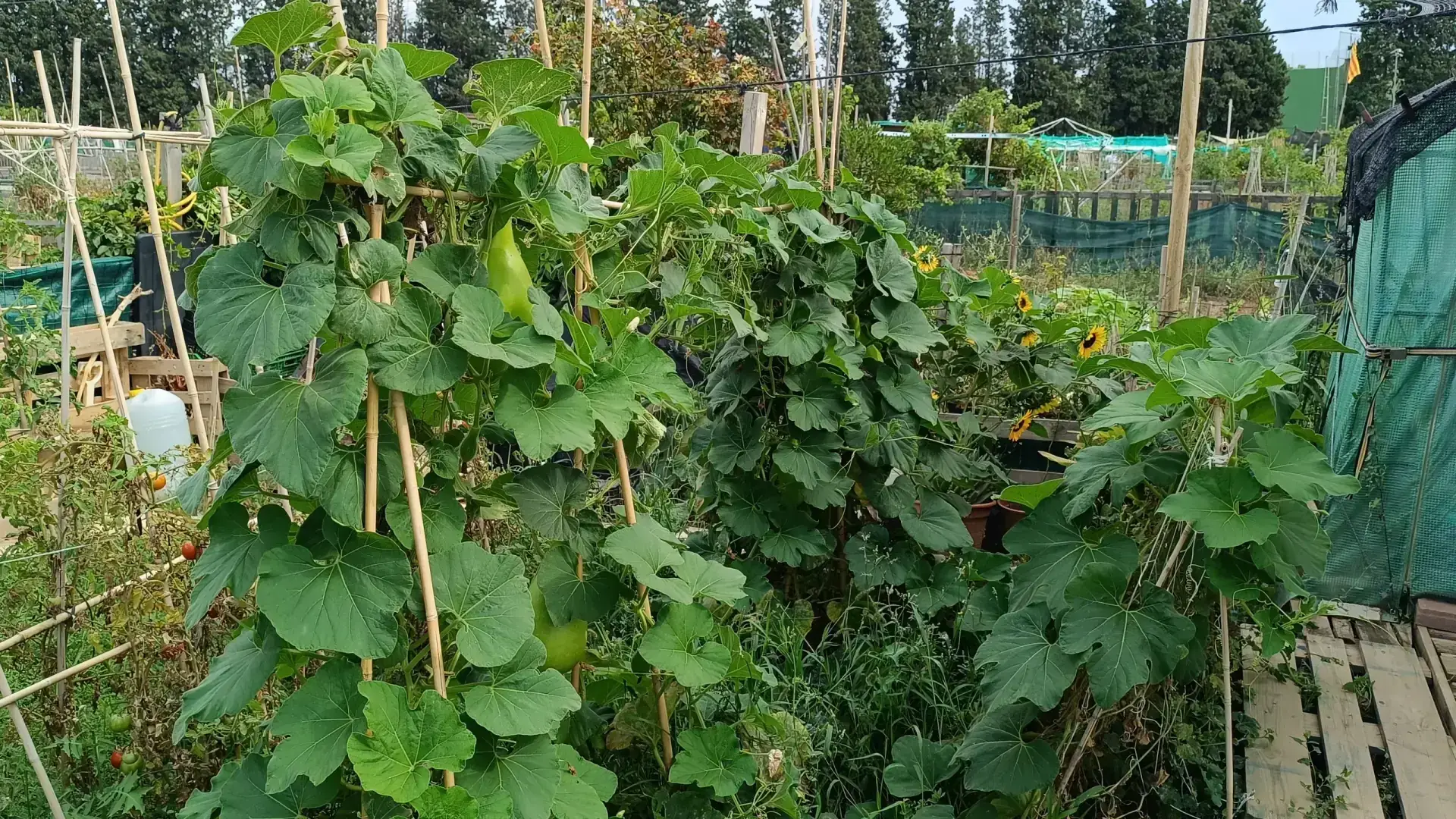
Bottle Gourd Bottle Gourd

Bottle Gourd

Variety: Bottle Gourd

Lagenaria siceraria

About this Crop

The bottle gourd (Lagenaria siceraria), also known as calabash, birdhouse gourd, or white-flowered gourd, is a climbing cucurbit cultivated for thousands of years not only as food but also as a raw material for making containers, utensils, and musical instruments. It is one of the first plants domesticated by humanity.

It is an annual climbing plant with long stems that can reach 5-10 meters in length, equipped with branched tendrils. The leaves are large, heart-shaped or rounded, with a velvety texture and a characteristic musky aroma. It produces white flowers — unlike pumpkins and zucchinis that have yellow flowers — which open at dusk and are pollinated by nocturnal moths.

The fruits are extremely variable in shape and size depending on the variety: from elongated and thin bottles to rounded, pear-shaped, or elongated forms. The skin is smooth and light green when young, turning to beige-brown and hardening into a woody shell as it dries. The young flesh is edible, but the main value of the bottle gourd lies in its use as an artisanal container once dried.

History & Origin

The bottle gourd (Lagenaria siceraria) is one of the oldest domesticated plants in human history, with archaeological evidence dating back more than 10,000 years on several continents. Its origin appears to be in Africa, from where it spread to Asia, the Americas, and Europe through natural dispersal (its fruits float and can cross oceans) and human migration.

In ancient China, it was cultivated more than 7,000 years ago and was used both as food and to make containers, ladles, and musical instruments. In pre-Columbian America, it arrived thousands of years before Columbus and was a fundamental plant for indigenous cultures, who used it as a container for water and food, as well as to make rattles and ritual instruments. In Africa, it continues to be an essential plant for making utensils, drums (kora), and containers.

In traditional Mediterranean agriculture, the bottle gourd was a common plant in family gardens, where it was used to make water bottles, wine containers, and decorative birdhouses. Although its cultivation has declined with the arrival of plastic materials, it is experiencing a resurgence due to interest in traditional crafts and sustainability.

Ideal Companions

CornBeanRadishMarigoldSunflower

Avoid

PotatoCucumberZucchiniMelonWatermelon

Superfood

The young fruits of bottle gourd are low in calories (about 14 kcal per 100 g), composed of more than 95% water. They provide vitamin C, B-complex vitamins, potassium, calcium, and fiber. In traditional medicine, it is used as a diuretic and digestive. The mature fruits and the woody shell are NOT edible and are used exclusively for artisanal purposes.

Preservation

Young fruits are consumed fresh and keep in the refrigerator for about a week. For use as a container, fruits are left to dry completely on the plant at the end of the season. Once harvested, they are stored in a cool, dry, and well-ventilated place for several months until the shell is completely woody and the seeds rattle inside when shaken. Drying can take 6 to 12 months.

Pest Monitoring

Pay special attention to: Aphid, whitefly, red spider mite, powdery mildew.

FAQ

Is it edible

Only the young and tender fruits are edible. When they mature and the shell hardens, they stop being edible and are used only for artisanal crafts or decoration.

How long does it take to dry

Drying can take between 6 and 12 months, depending on the size of the fruit and environmental conditions. It should be in a cool, dry, and well-ventilated place.

Can it be grown in a pot

It is difficult due to its vigor and size (it can reach 10 meters). It needs a very large pot (minimum 50 liters) and a very sturdy support structure.

What can be done with the dried fruit

Containers, water bottles, birdhouses, lamps, spoons, musical instruments (maracas, kora), floats for fishing nets, and all kinds of crafts.

Notas

The bottle gourd is a plant that connects us with the oldest human history and with artisanal traditions that are being lost. Its cultivation is more an act of cultural preservation than a source of food. In the home garden, it provides shade in summer if grown on a pergola and its white flowers, which open at dusk, offer a unique nocturnal spectacle. Each dry fruit is a unique and unrepeatable canvas for painting, pyrography, or carving.