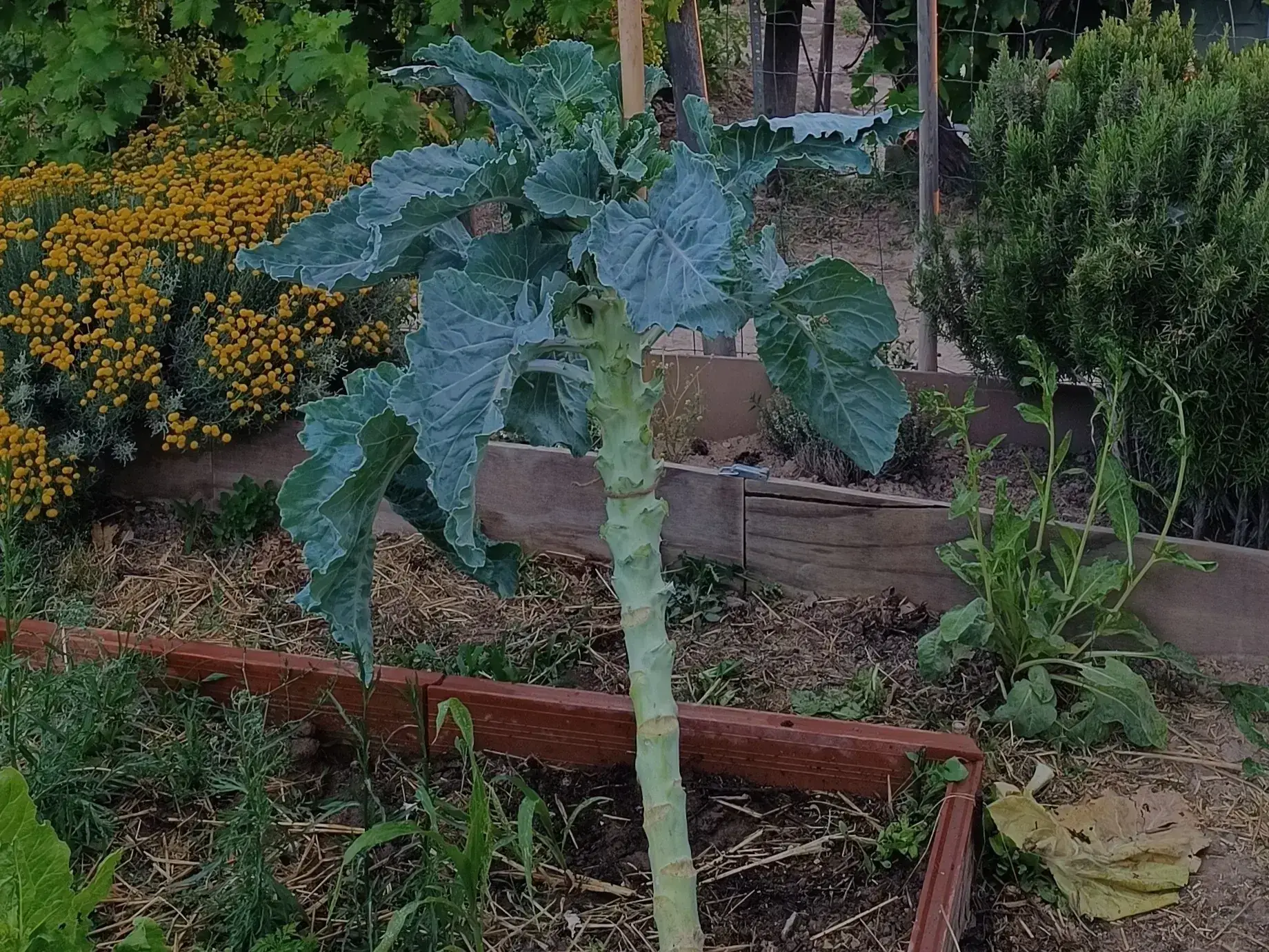
Walking Stick Kale Walking stick

Walking Stick Kale

Variety: Walking stick

Brassica oleracea var. longata

About this Crop

Walking Stick kale (also known as Jersey kale, stick cabbage, chou cavalier, or tree cabbage) is one of the most extraordinary and unique kale varieties in the world. Its most distinctive feature is its extremely long woody stem, which can reach between 2 and 6 meters in height, topped by a small rosette of edible leaves, resembling a palm tree.

It belongs to the Brassicaceae family and is a slow-growing biennial plant. Unlike other kales grown for their leaves, Walking Stick is mainly grown for its stem, which when dried becomes a strong and lightweight walking stick or staff. The bluish-green, rough-textured leaves are edible like other kales, though traditionally used as livestock fodder.

It is a traditional (heirloom) variety originating from the Channel Islands (Jersey), where it was an economically important crop during the 18th and 19th centuries. Its cultivation requires patience, needing a full season to develop a stem of sufficient size to become a walking stick.

History & Origin

Walking Stick kale originates from the Channel Islands, a British archipelago off the coast of Normandy (France), primarily the island of Jersey. During the 18th and 19th centuries, this plant was an economically important crop in the region.

The story goes that the islanders, faced with a shortage of wood for making walking sticks and tools, discovered that the stems of this cabbage, when dried, became as strong as wood. They began growing it specifically for this purpose, stripping the lower leaves to force vertical stem growth. The removed leaves were used as livestock fodder, especially for cows and sheep, creating a system of integral plant use.

At its peak, in the early 20th century, up to 30,000 walking sticks per year were exported from Jersey to the United Kingdom and Europe. The sticks were appreciated for being lightweight, strong, and flexible. The variety was documented by botanist and explorer John Gerard in his famous Herball of 1597, showing it has been cultivated for over 400 years. With modern materials and the decline of traditional agriculture on the islands, its commercial cultivation nearly disappeared but has been maintained by seed collectors and gardeners passionate about historic varieties.

Ideal Companions

DillRosemarySageMintNasturtiumMarigoldGarlic

Avoid

CabbageBroccoliCauliflowerBrussels sproutsArugula

Superfood

Walking Stick kale leaves share the nutritional profile of other kales: rich in vitamin K, vitamin A, vitamin C, fiber, calcium, iron, and potassium, with very low calories. However, the most unique value of this plant lies not in its nutrition but in its functional use as a material for crafting unique artisanal walking sticks.

Preservation

Tender leaves keep in the refrigerator for 3 to 5 days. The stem, once harvested, undergoes a drying process of approximately one year in a cool, dry, ventilated place. Once dry, it is sanded to remove leaf scars and varnished to protect the wood, becoming a functional walking stick that can last for years. Traditionally, a metal ferrule was added to the base to protect the tip.

Pest Monitoring

Pay special attention to: Aphid, caterpillar, whitefly, downy mildew, slug.

FAQ

Can it really be used as a walking stick

Yes, dried and varnished stems are perfectly functional as walking sticks. They are lightweight, strong, and have a very attractive rustic look. They are sold in specialty shops and craft fairs.

How long does it take to grow enough

To obtain a useful-sized walking stick (1.5-2 meters), the plant needs at least one full growing season (8-10 months), plus an additional year of drying. It is a slow-growing plant but the result is worth the wait.

Do the leaves taste good

Young, tender leaves are edible with a flavor similar to other kales, though more intense and fibrous. Mature leaves are very tough and were traditionally used as animal fodder. Only the tenderest upper leaves are recommended for consumption.

Where can I get seeds

As a rare variety, it is not found in conventional garden stores. Look in heirloom seed catalogs like Baker Creek (USA), or seed preservation associations.

Notas

Walking Stick kale is one of the most unusual and fascinating horticultural varieties in the world, a perfect example of how a plant can have totally unexpected uses beyond food. Its cultivation is more a historical and artisanal curiosity than a food source, but it deserves a place in every heirloom variety garden for its ornamental, historical, and conversational value. On the island of Jersey, where it originated, it forms part of the agricultural heritage and efforts have been made to recover its traditional cultivation. In English it is also known as Jersey cabbage or tree cabbage.