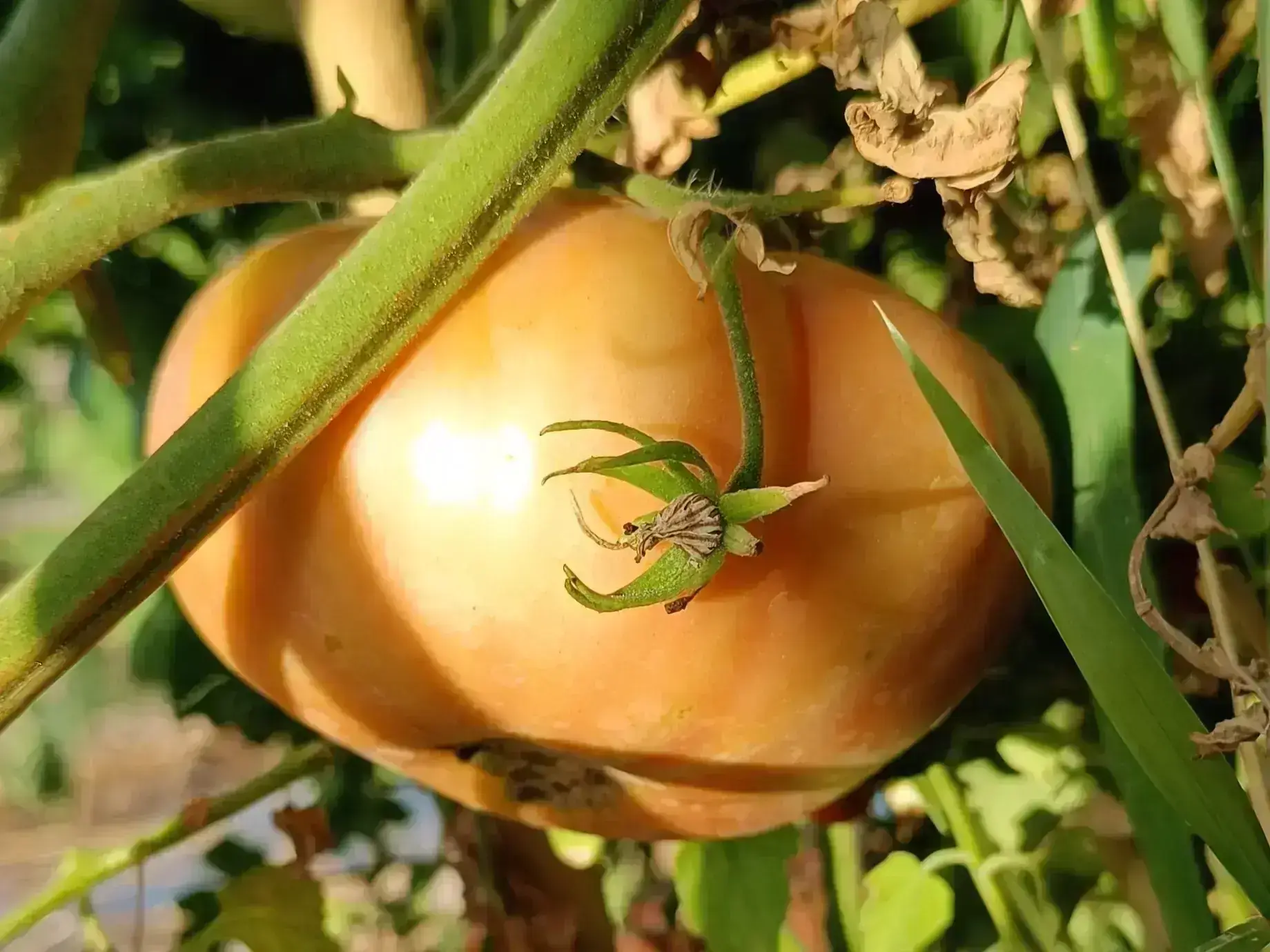
Olivia Tomato - Complete Guide Olivia

Olivia Tomato - Complete Guide

Variety: Olivia

Solanum lycopersicum

About this Crop

The Olivia tomato is a traditional open-pollinated variety recently rescued from a farmer in Málaga, in the heart of the Guadalhorce Valley. It belongs to the lineage of the «Huevo de Toro» (Bull's Egg) tomatoes, the emblematic large Andalusian pink tomatoes of exceptional flavour. It came into our collection through an exchange with another grower, as part of the movement to recover local varieties that for decades survived in family vegetable gardens in Málaga, passed down from generation to generation.

It belongs to the Solanaceae family, along with potato, aubergine, and pepper. It is an indeterminate and very vigorous plant, capable of reaching 2-2.5 metres in height when properly staked. Its stems are robust and its leaves are large and lush, essential for protecting the fruit from the direct sun of the Andalusian summer and promoting slow, even ripening.

The fruits are large, with an average weight of 400-600 grams, and can exceed one kilogram under optimal conditions. The shape is flattened, heart-shaped, and slightly irregular, with the characteristic green shoulders that remain even when the fruit is fully ripe — a hallmark of authenticity in the variety, not a sign of immaturity. The skin is thin and delicate, with an intense dark pink colour that turns red at full maturity. The flesh is meaty, velvety, and dense, with few seeds, low water content, and an intense, balanced flavour between sweetness and acidity, reminiscent of tomatoes from times past. Each truss produces only 1 or 2 fruits, allowing the plant to concentrate all its energy on developing large-calibre tomatoes of superior organoleptic quality.

History & Origin

The Olivia tomato belongs to the family of «Huevo de Toro» (Bull's Egg) tomatoes from the Guadalhorce Valley in the province of Málaga. The Huevo de Toro is a traditional Andalusian variety that was on the brink of extinction in the 1990s and 2000s, when intensive agriculture imposed thick-skinned, tasteless but transport-friendly commercial hybrids. For decades, the seeds of the authentic Málaga tomato survived thanks to the perseverance of market gardening families in the Guadalhorce, who kept them for their own consumption.

The modern rescue of the Huevo de Toro began around 2010 and has its own key figures: agricultural technician Margarita Jiménez and farmer Sebastián Hevilla, manager of the Guadalhorce Valley Rural Development Group (GDR), were crucial. The Hevilla family is recognised as pioneers in maintaining the seeds during the variety's dark years. The support of local restaurateurs committed to local produce created the necessary demand for farmers to grow it profitably again.

Our Olivia selection comes from seeds rescued from a farmer in the Málaga region and obtained through an exchange with another grower, as part of the informal network of seed guardians that keeps Andalusian agricultural biodiversity alive. It represents a line selected for its dark pink colour, its generous size (around 500 g), and its low fruit production per truss, a trait that concentrates flavour and quality in each tomato.

Today, the Huevo de Toro tomato is a gastronomic symbol of Málaga, protected by the «Sabor a Málaga» brand and celebrated annually at the Coín contest and auction, where the best boxes are awarded. More than fifty restaurants participate in its gastronomic route, and its cultivation has become a driver of agritourism in the region.

Ideal Companions

BasilCalendulaGarlicOnionNasturtiumParsleyCarrotBorage

Avoid

PotatoEggplantPepperCabbageBroccoliFennelCorn

Superfood

As a traditional dark-fleshed variety, the Olivia tomato is an exceptional source of lycopene, the powerful antioxidant responsible for its intense pink colour and associated with cardiovascular health benefits and the prevention of certain types of cancer. It also provides beta-carotenes (provitamin A), vitamin C (approximately 20 mg per 100 g), vitamin K, and minerals such as potassium, essential for muscle function and blood pressure regulation. It is a very low-calorie food (approximately 20 kcal per 100 g) with high water content (over 93%), making it an excellent natural hydrator. Traditional varieties like Olivia show, according to various studies, higher concentrations of antioxidants than modern commercial hybrids, which are selected for intensive production rather than nutritional quality.

Preservation

The Olivia tomato, like all tomatoes in the Huevo de Toro family, has very thin skin and tender flesh, making it fragile and unsuitable for long transport. It should be consumed within 3-5 days of harvest. It keeps best at room temperature, in a cool, dry place, never in the refrigerator for fresh consumption, as the cold destroys its aromatic compounds and alters its velvety texture. If very ripe, it can be refrigerated for 2-3 days, taking it out at least 30 minutes before eating to recover temperature and aroma. For long-term preservation, its dense, low-water flesh makes it ideal for making sauces, artisanal preserves, and gazpachos that can be vacuum-packed or frozen. The fruits can also be dehydrated at low oven temperature and preserved in extra virgin olive oil with herbs for months.

Pest Monitoring

Pay special attention to: Aphid, whitefly, spider mite, caterpillar, powdery mildew, Tuta absoluta, blossom end rot.

FAQ

Why does it have green shoulders when ripe

Green shoulders are a genetic characteristic of the variety and a sign of authenticity, not immaturity. Many large traditional tomatoes retain green colouring in the peduncle area even when fully ripe. To check if it is ready, gently press the base of the fruit: it should yield slightly to the touch.

Can it be grown in a pot

It is not the most advisable. Due to its indeterminate habit (up to 2.5 metres) and the weight of its fruits (400-600 g), it needs a large volume of substrate and firm staking. If grown in a pot, it must be at least 40-50 litres, with a sturdy support and very frequent watering. Its natural place is in the garden soil.

Why does it only produce 1 or 2 tomatoes per truss

This is a desirable characteristic of the variety. By producing few fruits per truss, the plant concentrates all nutrients, water, and sugars in each tomato, resulting in much larger, meatier, and more flavourful fruits than varieties with many fruits per cluster. It is the difference between quantity and quality.

How do I prevent the fruits from cracking

Cracking is caused by irregular watering. When the tomato receives abundant watering after a dry period, the interior grows faster than the skin, causing it to split. The key is to maintain consistent moisture in the soil, without alternating drought with waterlogging. Mulching helps stabilise moisture.

Is it the same as the Huevo de Toro tomato

It belongs to the same varietal family, but Olivia is a specific selection from a seed line rescued from a Málaga farmer and preserved through exchange between growers. Within the Huevo de Toro population, there are slight variations in colour, shape, and size. Olivia stands out for its darker pink hue and its especially meaty fruit.

Notas

The Olivia tomato represents everything a tomato should be: flavour, history, and biodiversity. It is the result of the quiet resistance of generations of growers who kept their seeds when the market told them these varieties «weren't useful». Each Olivia fruit is a small victory against genetic uniformity and a reminder that the best varieties are not always in commercial catalogues, but in the gardens of those who never stopped growing them. Obtaining this variety through exchange with another grower makes it a living part of our cultivated biodiversity collection, a genetic and cultural heritage that deserves to be preserved and shared. Its open-pollinated seeds can be saved year after year and progressively adapted to the conditions of each garden.