Salduie Melon - Complete Growing and Care Guide Salduie

Salduie Melon - Complete Growing and Care Guide

Variety: Salduie

Cucumis melo

About this Crop

The Salduie Melon is an experimental F1 hybrid obtained through natural cross-pollination between the Ho Chi Minh Melon (Vietnamese tropical variety, maternal parent) and the Cantaline Melon (commercial F1 hybrid of Cantaloupe × Honeydew, paternal parent). The name pays tribute to Salduie, the ancient Iberian city that occupied the site of present-day Zaragoza, where this unique cross was developed.

It is a three-way genetic hybrid with the composition 50% Ho Chi Minh × 25% Cantaloupe × 25% Honeydew. This combination produces a plant with a very characteristic phenotype combining traits from all three ancestors in a single generation.

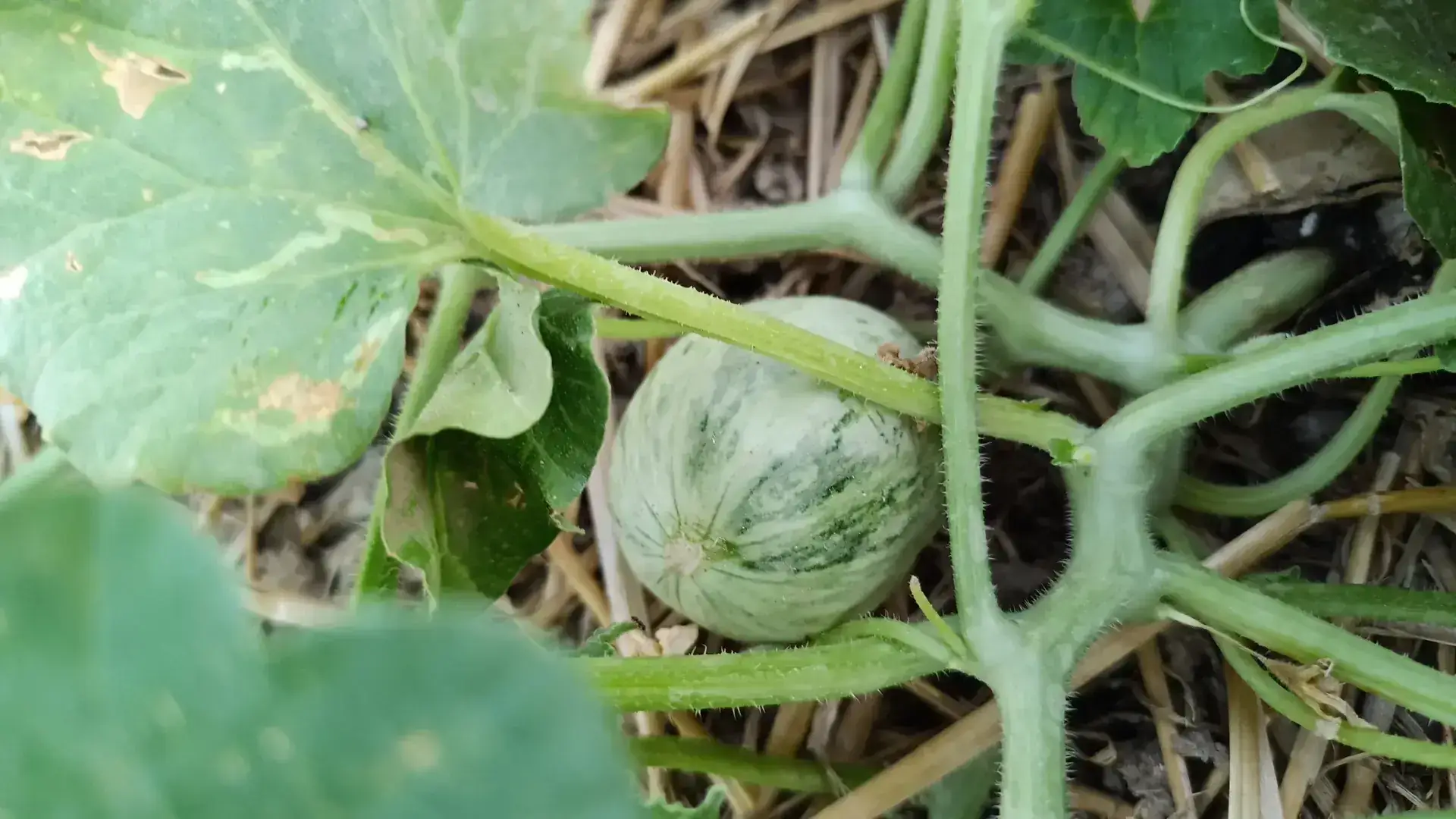
The plant has a creeping habit, with thin stems (dominant inheritance from Ho Chi Minh). The leaves present a more circular and rounded shape, a trait inherited from Cantaloupe via Cantaline. The fruit is small, weighing between 100 and 250 grams, a size reflecting Ho Chi Minh's heritage. The skin is of a light, whitish or cream tone, a trait from Honeydew (via Cantaline), and features a very special decoration: scattered green spots on the light background, an echo of the characteristic tiger-striped pigmentation of Ho Chi Minh.

The Salduie Melon is not a stable commercial variety, but an experimental hybrid in the documentation phase. If seeds from these fruits (F1) are saved and planted next year, identical copies will not be obtained. In the F2 generation, there will be a massive genetic segregation with great diversity of shapes, colors, and flavors. This project is part of the philosophy of participatory plant breeding, where the grower becomes a researcher and breeder of their own varieties.

History & Origin

The history of the Salduie Melon begins with a happy accident of nature in a Zaragoza garden. During the growing season, two melon varieties of very different origins shared the same space: the Ho Chi Minh Melon, a traditional Vietnamese variety adapted to tropical climates, and the Cantaline Melon, a modern commercial hybrid resulting from the cross between Cantaloupe and Honeydew.

Pollinators —bees, bumblebees, and other insects— did their work naturally, transporting pollen from Cantaline to the flowers of Ho Chi Minh. The resulting fruit, although outwardly a Ho Chi Minh, carried inside hybrid seeds with a unique genetic combination.

The following year, those seeds were planted and revealed their true nature: all the plants were F1 hybrids, showing a fascinating combination of traits from both parents. The discovery was named Salduie Melon, in honor of the ancient Iberian city that occupied the site of present-day Zaragoza, a name that symbolizes the union between the Vietnamese tropics (Ho Chi Minh) and the Mediterranean (Cantaloupe/Honeydew) in Aragonese lands.

The exact genetic composition of this hybrid is 50% Ho Chi Minh (direct maternal parent, Vietnamese tropical variety) and 50% Cantaline (paternal parent, commercial F1 hybrid). Within that 50%, the Cantaline contributes 25% Cantaloupe (Cucumis melo var. cantalupensis) and 25% Honeydew (Cucumis melo var. inodorus). The genetic formula is Ho Chi Minh × (Cantaloupe × Honeydew). This means that the Salduie Melon is not a simple cross of two pure varieties, but a three-way cross that brings together in a single plant the heritage of three distinct melon lineages.

If seeds from the current fruits (F1) are saved and planted, in the next generation (F2) the phenomenon of genetic segregation will occur. Mendel's laws predict that the traits of the three grandparents (Ho Chi Minh, Cantaloupe, and Honeydew) will randomly recombine, generating an explosion of diversity: fruits of different sizes, colors (white, green, orange, tiger-striped, netted), leaf shapes, and completely different flavor profiles. The grower can then select the specimens that best suit their preferences, starting their own plant breeding program.

Ideal Companions

CornBeanRadishMarigoldNasturtiumOregano

Avoid

MelonCucumberZucchiniWatermelonPumpkinPotatoGarlicOnion

Superfood

The Salduie Melon, like all melons, is a food with very low caloric intake (approximately 30-34 kcal per 100 g) with more than 90% water content, making it an excellent natural hydrator. It is rich in vitamin C, which strengthens the immune system, and vitamin A in the form of beta-carotenes. It provides potassium, an essential mineral for muscle and cardiovascular function, and fiber that promotes intestinal transit. Due to its Honeydew heritage, it is likely to contain antioxidants such as lutein and zeaxanthin, beneficial for eye health.

Preservation

Salduie Melon fruits, due to their small size and thin skin, keep best unwashed in the refrigerator, where they last approximately one week. Once cut, they should be consumed within 2-3 days. The flesh can be frozen in pieces for later use in smoothies, sorbets, or slushies. To appreciate all its aroma, it is recommended to consume them at room temperature on the day of harvest.

Pest Monitoring

Pay special attention to: Aphid, whitefly, red spider mite, downy mildew.

FAQ

Is it a stable variety?

No. The Salduie Melon is an experimental F1 hybrid, not a fixed commercial variety. If you save its seeds and plant them, you will get very diverse plants (F2 generation), not identical copies. It is part of an ongoing participatory plant breeding project.

Why is it called Salduie?

In honor of Salduie (also known as Salduba), the ancient Iberian Sedetan city that occupied the site of present-day Zaragoza before the Roman foundation of Caesaraugusta. The name symbolizes the meeting between the Vietnamese tropics and the Mediterranean in Aragonese lands.

What does it taste like?

As an experimental first-generation hybrid, the flavor profile is yet to be fully documented. By its genetic heritage (Ho Chi Minh × Cantaloupe × Honeydew), a sweet and aromatic flavor is expected, with possible tropical notes from Ho Chi Minh combined with the sweetness of Cantaloupe and the freshness of Honeydew.

Can it be grown in a pot?

Given its creeping habit with thin stems and small fruit (100-250 g), it is more viable in a pot than other larger melon varieties. A pot of at least 30 liters with a trellis to guide the plant vertically is recommended.

Where do its parents come from?

The Cantaline Melon is a modern hybrid of Cantaloupe and Honeydew (see its complete file for more details). The Ho Chi Minh Melon is a traditional Vietnamese variety for which we do not yet have a technical sheet on the website. Both were grown together in the same garden, allowing natural cross-pollination.

How long does it take to germinate?

Seeds germinate in 7 to 10 days under optimal temperature conditions (20-30°C). It is recommended to sow in a protected seedbed 3-4 weeks before the last frost.

Notas

The Salduie Melon represents participatory plant breeding applied to the home garden: natural cross-pollination, guided by the grower's observation and selection, can give rise to new genetic combinations adapted to a specific climate and terrain. As an F1 hybrid, this generation shows uniformity (all plants are phenotypically similar), but diversity —and the opportunity to select— appears in the F2 generation. This document is a living file that will be updated as the project progresses and new observations are documented.